7 min · Written by a Crohn's patient on biologic therapy
This article is based on personal patient experience and published guidelines. It does not replace your doctor's advice. Always consult your gastroenterologist before making changes to your treatment.
There's no universal list of foods that cause Crohn's flares. Every gastroenterologist will tell you this, and yet most patients spend months, sometimes years, trying to figure out which foods are making them worse.
The problem isn't that the information doesn't exist. It's that generic food lists don't account for the one variable that matters most: your body, your disease location, your current level of inflammation.
This guide is about building your personal list, not copying someone else's.
Why the Same Food Affects Patients Differently
Crohn's disease can affect any segment of the digestive tract, and the location matters enormously for food tolerance:
- Ileal Crohn's (small intestine), often associated with difficulty digesting high-fat foods, fibrous vegetables, and certain complex carbohydrates
- Colonic Crohn's, may involve sensitivity to fermentable foods, certain sugars, and foods that speed up transit
- Perianal disease, spicy foods and caffeine often worsen local inflammation and discomfort
This is why generic "Crohn's foods to avoid" lists are a starting point at best, and potentially misleading at worst.
Common Trigger Categories (and Why They Matter)
High-insoluble fiber foods. Raw vegetables, cruciferous vegetables (broccoli, cabbage, cauliflower), seeds, skins, raw kale, corn, popcorn, and sunflower seeds can mechanically irritate an inflamed gut wall. During a flare, insoluble fiber may worsen diarrhea and cramping. During remission, many patients tolerate these foods well.
Dairy products. Lactose intolerance is more common in Crohn's patients than in the general population, partly due to reduced lactase enzyme production in an inflamed small intestine. This can mimic Crohn's symptoms, making dairy appear to "trigger" a flare when it's actually a separate intolerance issue.
Fatty and fried foods. High-fat foods stimulate stronger intestinal contractions and can accelerate transit, worsening diarrhea. This effect is amplified when the ileum is affected and bile acid absorption is impaired.
High-FODMAP foods. Fermentable oligosaccharides, disaccharides, monosaccharides, and polyols, found in onions, garlic, apples, wheat, legumes, and many processed foods, are fermented by gut bacteria. In a dysbiotic gut, this fermentation can produce gas, bloating, and pain that mimic inflammatory symptoms.
Caffeine and alcohol. Both stimulate gut motility and can loosen stool. Alcohol also directly disrupts the intestinal mucosal barrier. Many patients find they tolerate small amounts during remission but not during active disease.
Spicy foods. Capsaicin activates pain receptors in the gut and can worsen cramping and urgency. Tolerance is highly individual.
NSAIDs. Not technically a food, but ibuprofen, naproxen, and aspirin taken for other pain can directly trigger or worsen Crohn's inflammation. Many patients discover this connection too late.
The Only Reliable Method: Your Personal Food Journal
Identifying your trigger foods requires data, not intuition, not a copied list from a forum.
The method that works is a crossover food journal: simultaneously tracking what you eat, how you feel, and your context (stress, sleep, medication timing). A food that's fine on a low-stress day may cause symptoms the same week as a work deadline. The food looks like the trigger when the real issue is the combination.
What to track:
- What you ate (focus on unusual or new items)
- Symptoms that day: stool frequency, pain level (0 to 10), energy (0 to 10)
- Context: stress level, sleep quality, days since last injection or infusion
How long to track: A minimum of 8 continuous weeks before drawing conclusions. Patterns from two or three weeks are not reliable.
How to identify a suspect: After 8 weeks, look back from each symptom spike. Which foods appear repeatedly before bad days but not before good ones?
How to Confirm (or Rule Out) a Trigger Food
- Remove the suspected food completely for 4 weeks. Monitor whether symptoms improve.
- Reintroduce it as the only new variable. Don't change anything else at the same time.
- Observe for 5 to 7 days. If symptoms return, the connection is likely real.
One important caveat: what triggers symptoms during active inflammation may be perfectly tolerated during deep remission. Your trigger list is not permanent, it evolves with your disease state.
What to Eat During a Flare vs. Remission
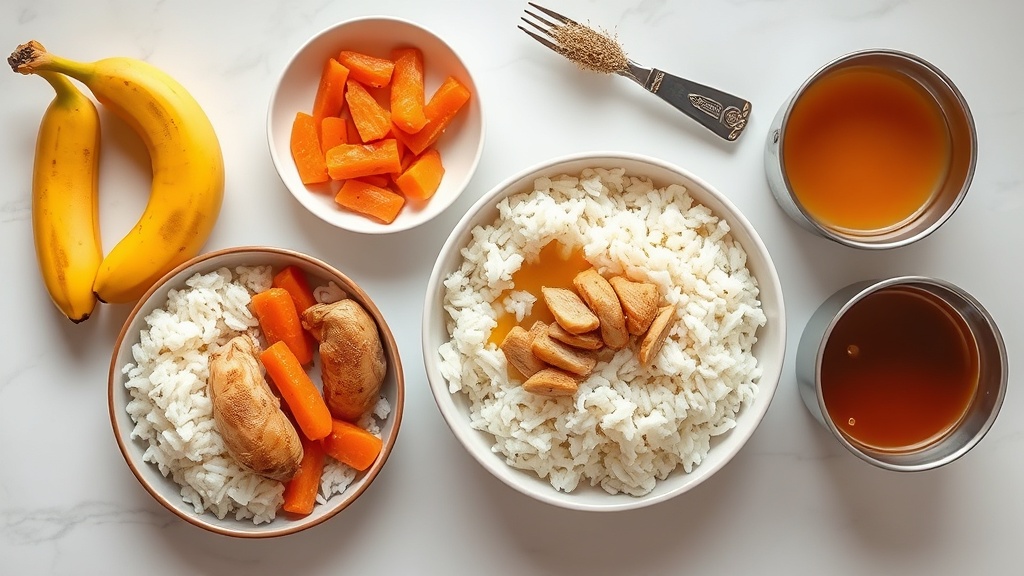
During a flare, low-residue approach:
- Well-cooked white rice, plain pasta, white bread
- Peeled, well-cooked vegetables (carrots, zucchini, potatoes)
- Ripe banana, smooth applesauce
- Chicken or vegetable broth
- Avoid: raw vegetables, high-fiber foods, dairy, spicy foods, caffeine, alcohol
During remission, building tolerance gradually:
- Reintroduce foods one at a time
- Start with cooked vegetables before raw
- Test higher-fiber foods in small quantities
- Keep a log of what you reintroduce and how you feel
The long-term goal is to have the least restrictive diet possible while staying well. Over-restriction can lead to nutritional deficiencies and reduced quality of life.
When to See a Dietitian
A registered dietitian with IBD experience can make a significant difference, particularly for identifying nutritional deficiencies, guiding a structured elimination protocol, and navigating low-FODMAP approaches. If your gastroenterologist hasn't referred you, ask.
Building Your Safe Foods List
The flip side of identifying triggers is identifying what's safe, foods you consistently tolerate well regardless of disease activity. This is equally valuable and often overlooked.
Your safe foods list is personal. For most Crohn's patients, a core of 10-15 foods emerges over time that can be relied on during difficult periods: specific proteins, starches, and vegetables that cause no reaction even during mild activity. Document these explicitly.
The goal isn't to eat only these foods forever. it's to have a reliable fallback during flares and travel, and to use them as a stable base when reintroducing suspects.
Working With a Dietitian
Self-directed food journaling is valuable, but a registered dietitian with IBD experience can significantly accelerate the process. They can:
- Help design a structured elimination protocol tailored to your disease location
- Identify nutritional deficiencies from restriction or malabsorption
- Guide a low-FODMAP approach if functional symptoms are suspected
- Help you build the least restrictive diet possible while staying well
If your gastroenterologist hasn't referred you to a dietitian, ask explicitly. IBD nutritional care is increasingly recognized as a key part of disease management, not an optional add-on.
The Low-FODMAP Approach: A Useful Tool, Not a Cure
The low-FODMAP diet (developed at Monash University) is well-established for irritable bowel syndrome and has been studied in IBD patients with functional symptoms. FODMAPs (fermentable oligosaccharides, disaccharides, monosaccharides, and polyols) are carbohydrates that ferment in the gut and can cause bloating, gas, and altered transit even without active inflammation.
For Crohn's patients, low-FODMAP is not a treatment for inflammation, but it can significantly reduce functional symptoms that overlap with inflammatory ones. Many patients discover that a proportion of their "flare-like" symptoms are actually functional and FODMAP-related, which is useful information for both self-management and medical decision-making.
The protocol involves three phases:
- Elimination phase (2-6 weeks): all high-FODMAP foods removed
- Reintroduction phase: one FODMAP group at a time, systematically tested
- Personalization phase: identify your specific FODMAP tolerances and build a sustainable diet
If your symptoms persist despite dietary adjustments, the issue may relate to inflammatory activity, see our guide on Crohn's disease biologic treatment and trough levels for more context.
Important caveat: low-FODMAP is not appropriate as a long-term permanent diet. it's too restrictive and can affect gut microbiome diversity. It's a diagnostic and short-term tool. Work with a registered dietitian experienced in IBD for best results. The Crohn's & Colitis Foundation offers a detailed diet and nutrition guide covering both low-FODMAP and other dietary approaches.
Keeping a Food Symptom Journal That Actually Works
Most food journals fail because they're either too detailed (impossible to maintain) or too vague (not actionable). Here's a format that balances rigor with sustainability:
What to record daily (2 minutes maximum):
- Any foods that were unusual or different from your normal baseline (not everything you ate)
- Stool frequency (number)
- Pain level (0-10)
- Energy level (0-10)
- Stress level (0-10)
- Any medication taken outside your normal routine
What NOT to record: Every single ingredient. The goal is to capture deviations from your normal pattern, not create a calorie log. If you eat the same breakfast every day, you don't need to log it. it's a constant, not a variable.
The review process (once per week, 10 minutes): Look backward from any symptom spike. What was different 24-72 hours before? This weekly review is where patterns emerge. Don't try to analyze in real time, wait for data to accumulate.
What to Ask Your Dietitian
A first appointment with a dietitian experienced in IBD is significantly more useful if you arrive with specific questions. Here are the most productive ones:
- "Based on my disease location, which food categories are most likely to cause problems for me?"
- "Should I try a formal low-FODMAP elimination protocol, or is a simpler food journal approach more appropriate for my situation?"
- "What nutritional deficiencies should I be tested for given my disease history and medications?"
- "How do I maintain adequate protein intake during a flare when my options are limited?"
- "Are there any supplements you'd recommend or advise against given my current treatment?"
A good IBD dietitian will individualize their approach based on your disease location, current treatment, and symptoms, not give you a generic Crohn's food list. If the recommendations feel generic, ask specifically how they apply to your situation.
If your gastroenterologist hasn't referred you to a dietitian, ask directly. Nutritional support is increasingly recognized as a core component of IBD management, not an optional extra.
Related Reading
- Crohn's Flare Management: A Step-by-Step Plan
- Managing Crohn's With Diet: What Works
- Crohn's and Stress: The Gut-Brain Connection
The Crohn's and Colitis Foundation provides additional guidance on symptom tracking and trigger identification.
Frequently Asked Questions
- Is there a specific Crohn's disease diet I should follow?
- No single diet is proven to treat or cure Crohn's disease. The most evidence-based approach is identifying your personal triggers through a structured food diary.
- Can I eat gluten with Crohn's disease?
- Unless you have confirmed celiac disease or gluten sensitivity, there's no evidence that gluten worsens Crohn's inflammation. Some patients feel better gluten-free, but this may reflect a reduction in other FODMAPs rather than gluten itself.
- Does diet affect whether I go into remission?
- Diet alone cannot induce or maintain remission, that requires medical treatment. However, certain dietary patterns can reduce symptom burden and support overall health during treatment.
- My trigger foods keep changing, is this normal?
- Yes. Food tolerance in Crohn's changes with disease activity, treatment, and gut microbiome shifts. Something that triggered symptoms during a flare six months ago may be fine today. Continuous tracking is more useful than a fixed list.
If your symptoms persist despite dietary adjustments, the issue may be related to your biologic treatment, see our guide on Crohn's disease biologic treatment and trough levels.
The goal isn't a perfect diet. For evidence-based dietary guidance, the Crohn's & Colitis Foundation provides a detailed IBD diet guide. It's enough information to make fewer bad days, and to stop blaming every meal when the real picture is almost always more complex.